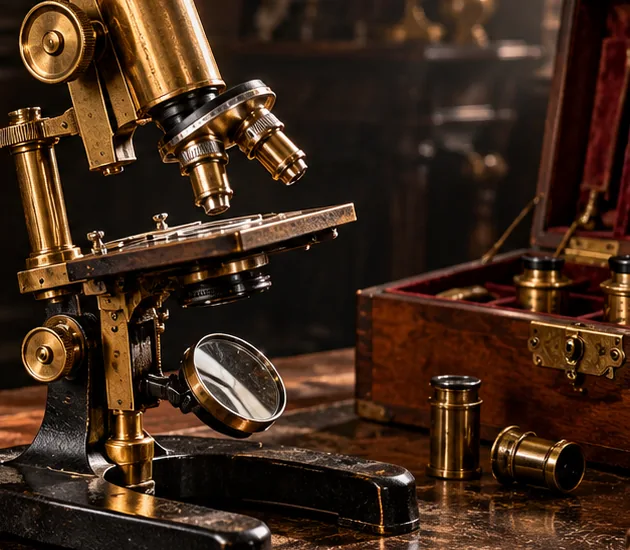
A practical investigation: nameplates, objectives, hinges, stages, and cases. These notes prioritize evidence over decorative language and make no claim to appraise an individual instrument.
Start with the maker’s signature
Look first at the foot, stage, body tube, and arm—not just the eyepiece. Many instrument makers engraved their names and addresses into brass components. Photograph the entire signature, including initials and street names. Do not assume that an objective marked Zeiss means the entire microscope was built by Zeiss: accessories can move between instruments over decades.
Read the stand before the finish
The silhouette often reveals more than the shine. A horseshoe-shaped foot, tripod base, curved limb, stage clips, rack-and-pinion tube, rotating nosepiece, and substage mirror are useful clues. Note the mechanical arrangement and compare it against dated museum examples. Decorative brass is not by itself proof of nineteenth-century manufacture.
Serial numbers can help—but not by themselves
Record the number exactly, including any prefix, and photograph where it is stamped. The same manufacturer may have used separate sequences for different product families. Cross-check catalog illustrations, museum entries and specialist publications rather than trusting an unsourced internet serial-number chart.
Inventory the accessories
Remove nothing forcefully. Count the objectives, eyepieces, condensers, mirrors, slides, stage clips, and any fitted case trays. A missing part may be replaceable, but not necessarily with a period-correct counterpart. Photograph every accessory before making a purchase decision.
Build an evidence-based identification
An honest identification reads: “Likely late nineteenth-century British compound microscope, attributed to [maker], based on engraved name and stage design; precise year unconfirmed.” This is stronger than a confident but unsupported “1850 museum rarity.” Use our condition checker to record physical details.