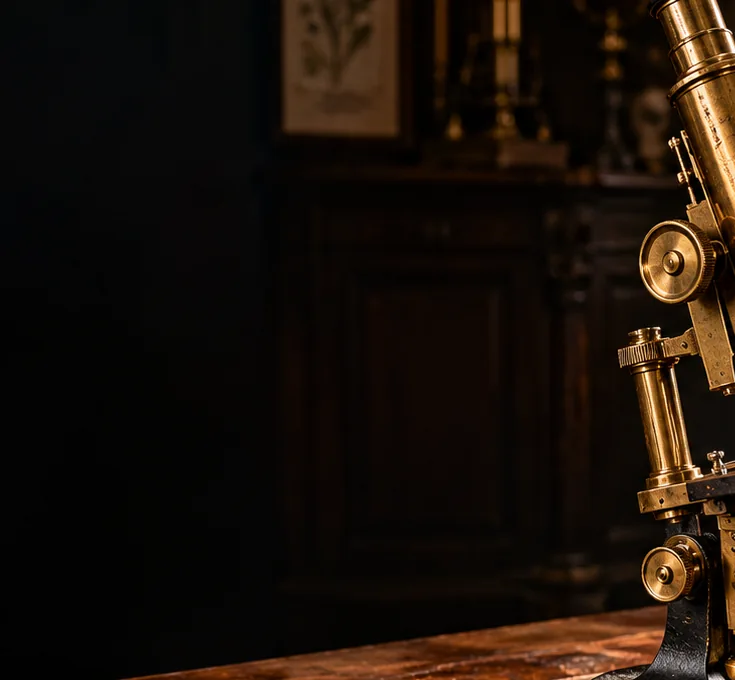
From 1700s pocket microscopes to the great optical workshops. These notes prioritize evidence over decorative language and make no claim to appraise an individual instrument.
1702: the pocket instrument
James Wilson described a small screw-barrel microscope in the early eighteenth century. The Smithsonian preserves a version with multiple lenses and a compact case, a reminder that historical microscopy was not always housed in a tall laboratory stand.
The eighteenth-century curiosity
Early portable and compound designs circulated among physicians, natural historians and wealthy amateurs. Collectors today encounter brass, wood, ivory, mirrors, and manually adjusted lens arrangements in these instruments. A convincing early claim requires credible provenance and comparison with documented examples.
The nineteenth-century workshop
Industrial precision and improved optical design changed the market. Instrument makers produced teaching, laboratory, field and research microscopes, with different mechanical capabilities and pricing. Maker signatures and catalog plates became crucial evidence for modern identification.
1872: optics become a calculation
According to ZEISS’s historical record, Ernst Abbe’s work enabled lens production based on theoretical calculation by 1872. The shift helped provide more predictable microscope performance than solely empirical lens-making. The collaboration with Zeiss and later optical-glass innovations reshaped the industry.
The collector’s modern view
Antique microscopes are artifacts of scientific culture, not merely display objects. Their bases, optics, cases and serial marks tell the story of laboratories, classrooms and individual makers. A beginner can start with a well-documented early twentieth-century specimen before chasing seventeenth-century rarities.