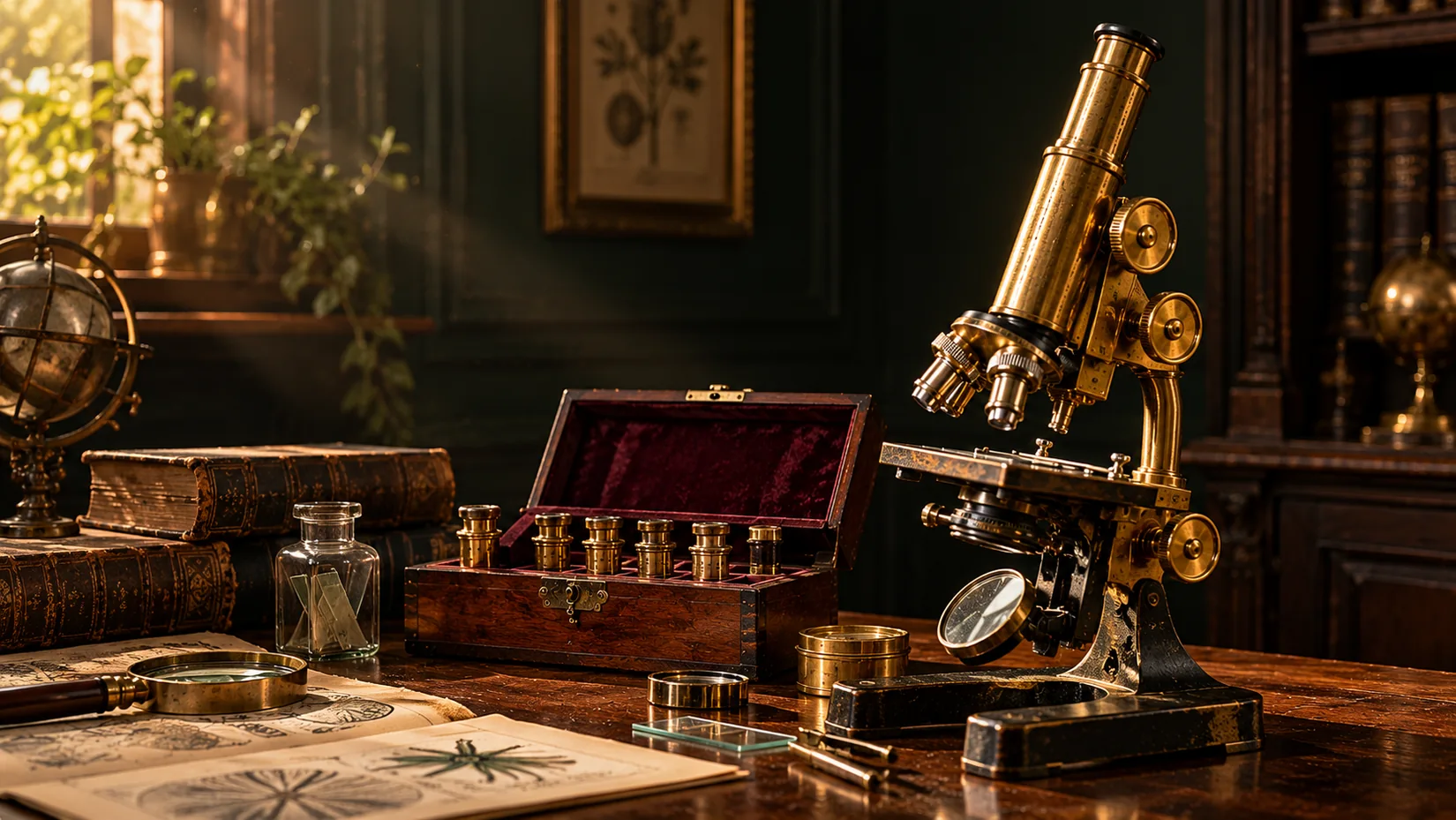
A microscope that looks like a miniature pavilion offers a window into the technology—and craftsmanship—of the early Enlightenment.
Why the silhouette matters
Culpeper-style microscopes are associated with the early eighteenth-century English instrument tradition and are recognizable in many examples by a multi-legged support surrounding the optical assembly. The Science Museum’s collections include an early microscope body and stand dated 1701–1730 and another example assigned to the mid-eighteenth century. These dated objects provide better comparisons than vague internet claims that any ornate tripod microscope must be ‘1700s.’
Wood, leather, brass and paper
Museum records reveal composite construction rather than a simple solid-brass fantasy: tubes may incorporate pasteboard or vellum, collars and legs use other materials, and cases may be pyramidal. This mixture is a major reason why photographs alone are not enough for a confident attribution. Surface texture, joints, missing material and historical repairs deserve careful examination.
Not every Culpeper is by Culpeper
A named design type can outlive its inventor or popularizer. ‘Culpeper-style’ means a family resemblance, not a signed manufacture by Edmund Culpeper. Even institutions may classify a similar object as an English or possibly Dutch example. A seller claiming a direct Culpeper workshop origin must provide more than a matching shape.
What to request before bidding
Look for full-view side and overhead images, close-ups of the stage, the objective assembly, leg joints and case. Ask what is mechanically functional without encouraging a risky demonstration. Document old restorations as part of the history instead of automatically calling them defects. Do not suggest aggressive polishing on objects with multiple historic surfaces.
How to build a reference set
Create a folder of cited institutional comparators: maker, object number, stated date range and distinctive construction details. Compare attributes, not a vague impression of age. The Science Museum entries linked below provide exactly the type of grounded object descriptions a collector should work from.
The attribution ladder
There is a useful hierarchy for describing a potential Culpeper instrument: “a compound microscope”; “an early-style tripod design”; “Culpeper-style”; “attributed to a particular maker”; and “signed and documented as the work of that maker.” Each rung requires additional evidence. Museum records use carefully qualified dating ranges because surviving instruments have complex histories and often lack conclusive provenance. A confident, single-year claim on an auction page should therefore be interrogated.
When comparing the construction, look beyond the familiar profile. Record the tube covering, number and arrangement of supports, stage design, screw fittings and any surviving case. The Science Museum’s early and mid-eighteenth-century records demonstrate that the materials and execution vary. If the listing omits photographs of the less glamorous joints and undersides, ask for them before paying a premium.
| Description | Confidence implied |
|---|---|
| Tripod microscope | Generic physical observation |
| Culpeper-style | Design-family resemblance |
| Attributed to Culpeper | Hypothesis requiring external support |
| Documented Culpeper instrument | High evidentiary burden, including provenance |
Research exercise: document observations and cite the source behind each attribution. These are evidence prompts, not expert authentication.