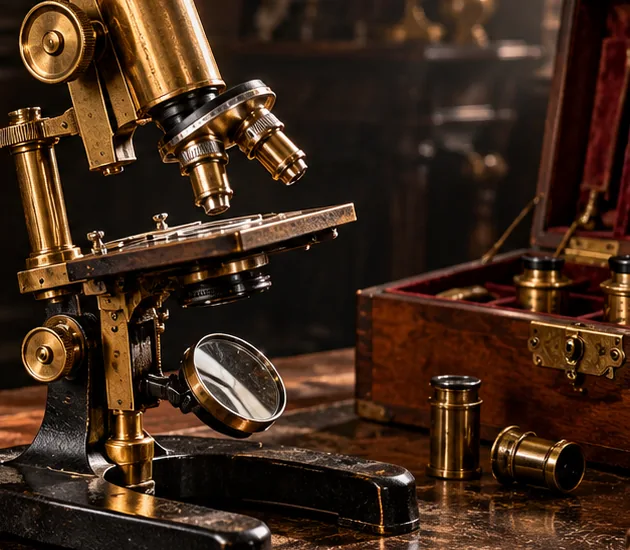
A convincing brass finish, a decorative wooden box and an antique-sounding title do not establish that an instrument is old.
Read the headline as a claim, not evidence
Search phrases like ‘Victorian,’ ‘rare,’ ‘museum,’ and ‘antique’ may simply reflect a seller’s understanding or marketing. The relevant facts are measurable: maker markings, dimensions, construction details, known model configuration, documented date range and condition. A listing that has photographs of only the shining front cannot support detailed claims about the optics or internal mechanism.
A suspiciously generic maker plate
Engraving is meaningful only in context. Compare its wording, placement, typography and fasteners with cited objects from the same maker. Be cautious of convenient generic labels or isolated engraved eyepieces. Equally, do not assume an unfamiliar mark proves a fake: instruments and accessories were made, repaired and retailed in diverse ways. The correct conclusion may be ‘not enough evidence.’
Hardware that does not match the narrative
Uneven or modern-looking fasteners, inexplicable decorative fittings, newly distressed wood or a mirror assembly unrelated to the supposed design warrant more photographs. But these are screening clues rather than a laboratory authentication procedure. A historic microscope may contain later functional repairs, and a reproduction can itself be an interesting collectible if it is sold honestly and priced as such.
Request an evidence pack
Ask for the maker plate and serial number, underside of the foot, full side elevation, stage, objectives, eyepieces, case interior and any invoices or provenance. Save the actual listing description and replies. Compare against institutional records by object number rather than social-media examples with uncertain attribution. Use our condition tool to record the unresolved questions.
Protect your downside
Check returns, shipping insurance, packing and whether the seller understands fragile glass and fitted cases. An appealing low purchase price can be undone by missing lenses, damage or unexpected freight. Our auction calculator models those costs; it does not predict an instrument’s market value. If the seller cannot support an attribution, value the object as unverified—not as the rarest possible interpretation.
Five seller questions that actually reduce uncertainty
Can you photograph the underside of the stand and any stamps? Will you provide close-ups of every maker mark and objective? Can you confirm the mirror, stage, focusing controls and case are the exact items pictured? Have you tested the optics, or only viewed the object visually? Will the instrument be packed with lenses and glass removed or separately protected where appropriate? The answers, and the seller’s willingness to answer, are often more informative than advertising adjectives.
You are not looking for a single magic fake-detection trick. Brass color, dust, engraving style and screw heads are all context-dependent. A reproduction may be sold in good faith as decoration; an original may have period repairs. Treat the attribution as a statement with varying degrees of confidence, and price the risk accordingly. Never claim that your checklist authenticates an item.
| Marketing phrase | What to ask instead |
|---|---|
| “Museum-quality” | Which institution and object record is comparable? |
| “Fully original” | Which parts and finishes are documented? |
| “Working” | What operation was tested and when? |
| “Rare” | What evidence establishes scarcity? |
Research exercise: document observations and cite the source behind each attribution. These are evidence prompts, not expert authentication.