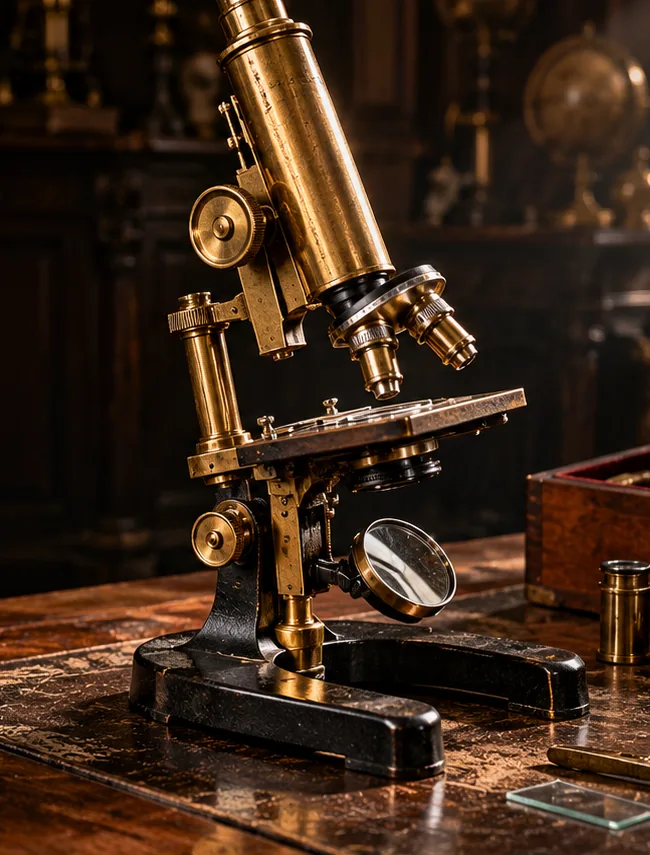
A place name, a number and a famous surname can provide clues—but none should become a made-up manufacture date.
Find every inscription before interpreting one
Engravings may appear on the tube, foot, stage, focusing mechanism, optics and case. Photograph them all before separating parts. A maker on the objective does not necessarily identify the maker of the body, and a retailer’s plate may not identify the workshop that manufactured the stand. The best research begins with a complete record of what is physically present.
City and street: useful, not infallible
London, Jena, Wetzlar or Rochester can narrow a research path, but businesses moved, successor companies retained familiar brand names, and later accessories circulated among older instruments. Do not use a city alone as a precise dating method. Look for dated maker catalogues or museum records that show the specific design and inscription pattern.
Numbers are not self-explaining
Science Museum records offer concrete examples: a Ross instrument catalogued as no. 2133 and a Crouch student microscope recorded as serial no. 5094. Those object numbers show the kind of evidence collectors should seek; they do not imply that numbers across makers share a single chronology. Some numbers identify a production series, others a model or an accessory.
The repair question
An instrument can acquire later objectives, stages or replacement screws through decades of scientific use. Such changes are part of its biography, but they matter to originality and price. Record mismatches without rushing to call them fraudulent. Compare the engraving style, wear and location across parts and seek a specialist opinion if a high-value attribution is at stake.
Write a defensible listing note
A useful description might be: ‘Brass compound microscope with body engraving reading [exact wording]; stand resembles documented late-nineteenth-century examples; objectives may be later; date unconfirmed.’ That precision earns trust. It also helps you compare new listings without turning a speculation into an established fact.
A repeatable inscription transcription protocol
Write down the characters exactly as they appear, preserving punctuation and line breaks. Include abbreviations and uncertain letters in brackets rather than silently “correcting” a familiar surname. Record whether the mark is engraved, stamped, painted or carried on a separate plate, and the precise part on which it appears. Photograph the lettering under angled light without rubbing or polishing it to improve legibility. These methods create useful evidence without altering the object.
When researching, separate maker, retailer, distributor, later repairer and accessory manufacturer. A single instrument can legitimately carry several names. Cross-check the full inscription against an institutional object entry or period catalogue; if a city address provides a possible date range, label it as a clue rather than a documented construction year. The most credible collector notes remain careful even when they cannot reach a definitive identification.
| Mark location | Possible interpretation |
|---|---|
| Main tube or foot | Potential stand maker or retailer |
| Objective barrel | Optical component maker |
| Case plaque | Original or later ownership / retailer clue |
| Separate numbered plate | Requires model-specific interpretation |
Research exercise: document observations and cite the source behind each attribution. These are evidence prompts, not expert authentication.