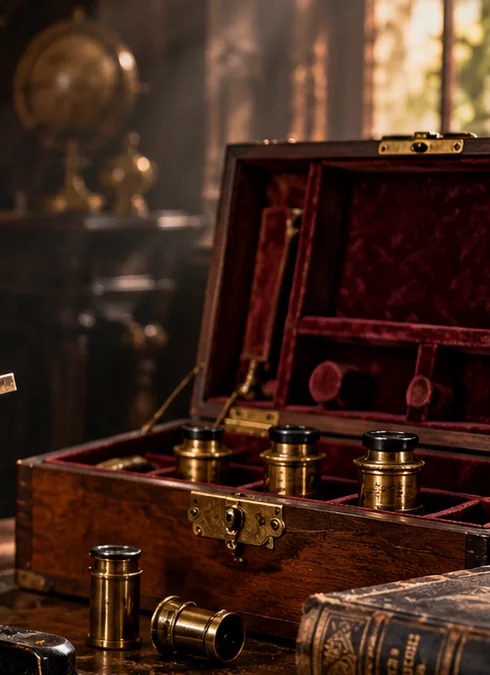
The most tempting number on eBay is usually the asking price. A disciplined collector learns to separate offers, sales, condition and provenance.
An asking price is not a transaction
A beautiful instrument listed at a high price proves only what its owner hopes to receive. A completed sale may provide stronger evidence, but even the final displayed price can omit negotiated terms, refunds, taxes and freight. Do not build a price guide by copying the top five active listings into a spreadsheet and averaging them. That produces false precision.
Normalize comparable objects
Start with maker and recognizable model family, then condition. Separate complete instruments from bare stands, loose objectives, parts lots, reproduction pieces and slide cabinets. Record original case, accessories, focus movement, optical condition and any documented restoration. Two microscopes with similar silhouettes may have very different market contexts if one carries a coherent original kit.
Date your evidence
Collect the date observed, listing URL, seller-description claims, listed or sold status, and any visible price. If a comparable disappears, preserve your own contemporaneous notes rather than implying it remains available. A local spreadsheet or our private collection ledger is useful for keeping records without presenting your own inventory as a public appraisal database.
Shipping and buyer risk are part of the price
A heavy brass stand with a fragile mirror, objectives and case may cost more to deliver safely than a compact pocket microscope. Taxes, destination charges and return arrangements also differ. Our auction calculator asks for those explicitly rather than pretending all buyers share the same landed cost. The right bid depends on the full acquisition, not the number beside the bidding button.
Confidence beats a fake price chart
Where directly comparable sold transactions are missing, say so. A credible range cannot be manufactured from three unrelated microscopes. Make your own tiered notes: strong match, partial match, poor match; recorded details and unresolved questions. Keep ‘what it sold for’ separate from ‘what I believe it may be worth.’
Your comparable-sale worksheet
For every usable comparable, record a dated link or screenshot, maker, stand type, completeness, optics, case, observed defects and transaction status. Do not mix a sold microscope with a “sold” parts lot without noting the distinction. When a completed auction displays a realized price, remember it still may not reflect private offers, refunds, taxes or shipping. Those limits matter if you later present an estimated range to someone else.
Build three baskets: close comparables (same or nearly same model and kit), context examples (related maker and era), and poor matches (parts, reproductions or fundamentally different instruments). Only the first group should carry much weight in a tentative valuation. If the close group is empty, that is not a problem to hide—it is an uncertainty to explain plainly.
| Field | Why record it |
|---|---|
| Sale status | Asking price is not completed sale |
| Maker and stand | Distinguishes models and generations |
| Accessories | Affects comparability and restoration expense |
| Date and link | Makes evidence auditable later |
Research exercise: document observations and cite the source behind each attribution. These are evidence prompts, not expert authentication.